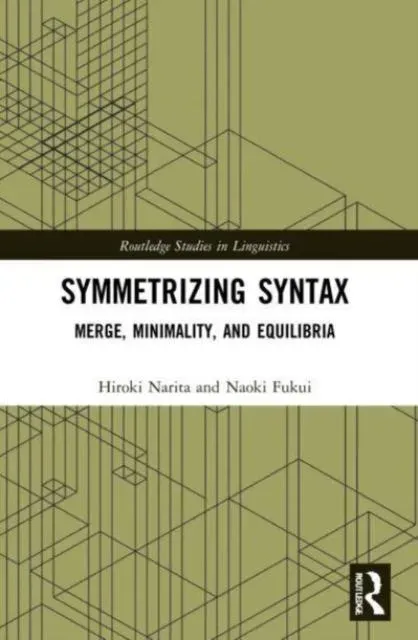
Symmetrizing Syntax: Merge, Minimality, and Equilibria
by Hiroki Narita
Title:
Symmetrizing Syntax: Merge, Minimality, and Equilibria
Author:
Hiroki Narita
Series (if any):
Routledge Studies in Linguistics
Edited by:
Naoki Fukui
Format:
Paperback
Number of pages:
330 pages, 254 Line drawings, black and white; 254 Illustrations, black and white
Publisher:
Taylor & Francis Ltd (Sales)
ISBN-13:
9781032148403
EAN:
9781032148403
Classifications:
Linguistics
Weight (g):
644
Dimensions (mm):
156 x 235 x 21
Publication Country:
United Kingdom
Language:
English
Condition:
New
Price:£50.39
1 copies in stock
Qty

Description
Symmetrizing Syntax seeks to establish a minimal and natural characterization of the structure of human language (syntax), simplifying many facets of it that have been redundantly or asymmetrically formulated. Virtually all past theories of natural language syntax, from the traditional X-bar theory to the contemporary system of Merge and labeling, stipulate that every phrase structure is 'asymmetrically' organized, so that one of its elements is always marked as primary/dominant over the others, or each and every phrase is labeled by a designated lexical element. The two authors call this traditional stipulation into question and hypothesize, instead, that linguistic derivations are essentially driven by the need to reduce asymmetry and generate symmetric structures. Various linguistic notions such as Merge, cyclic derivation by phase, feature-checking, morphological agreement, labeling, movement, and criterial freezing, as well as parametric differences among languages like English and Japanese, and so on, are all shown to follow from a particular notion of structural symmetry. These results constitute novel support for the contemporary thesis that human language is essentially an instance of a physical/biological object, and its design is governed by the laws of nature, at the core of which lies the fundamental principle of symmetry. Providing insights into new technical concepts in syntax, the volume is written for academics in linguistics but will also be accessible to linguistics students seeking an introduction to syntax.
Books in the same Series
Significance in Language: A Theory of Semantics
Jim Feist
£186.00
Language Contact and the Origins of the Germanic Languages
Peter Schrijver
£40.79
Books under Linguistics
Classical Rhetoric for the Modern Student
Robert J. (Professor of English Connors
£237.59

Natural History of Latin
Tore ( Janson
£9.89
Writing Degree Zero & Elements of Semiology
Roland Barthes
£10.72
Origins of Language
James R. (Emeritus Professor Hurford
£26.39

English Language
Leslie K. (Professor Arnovick
£97.20
The Phonetics and Phonology of Geminate Consonants
Oxford University Press
£137.81
VAGUENESS & THOUGHT OPM C
BACON
£123.26
Bad Language
Josh (Professor of Philosophy Dever
£32.39

More than Cool Reason
Mark Turner
£27.60
A Practical Introduction to Phonetics
J. C. Catford
£44.39