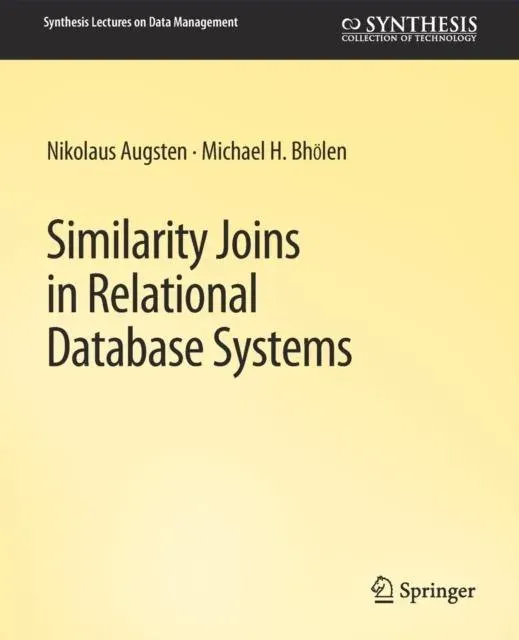
Similarity Joins in Relational Database Systems
by Nikolaus Augsten
Title:
Similarity Joins in Relational Database Systems
Author:
Nikolaus Augsten
Series (if any):
Synthesis Lectures on Data Management
Edited by:
Michael Bohlen
Format:
Paperback
Number of pages:
106 pages, XVII, 106 p.
Publisher:
Springer Nature B.V.
ISBN-13:
9783031007231
EAN:
9783031007231
Classifications:
Research and information: general
Weight (g):
368
Dimensions (mm):
234 x 190 x 11
Publication Country:
United Kingdom
Language:
English
Condition:
New
Price:£29.39
1 copies in stock
Qty

Description
State-of-the-art database systems manage and process a variety of complex objects, including strings and trees. For such objects equality comparisons are often not meaningful and must be replaced by similarity comparisons. This book describes the concepts and techniques to incorporate similarity into database systems. We start out by discussing the properties of strings and trees, and identify the edit distance as the de facto standard for comparing complex objects. Since the edit distance is computationally expensive, token-based distances have been introduced to speed up edit distance computations. The basic idea is to decompose complex objects into sets of tokens that can be compared efficiently. Token-based distances are used to compute an approximation of the edit distance and prune expensive edit distance calculations. A key observation when computing similarity joins is that many of the object pairs, for which the similarity is computed, are very different from each other. Filters exploit this property to improve the performance of similarity joins. A filter preprocesses the input data sets and produces a set of candidate pairs. The distance function is evaluated on the candidate pairs only. We describe the essential query processing techniques for filters based on lower and upper bounds. For token equality joins we describe prefix, size, positional and partitioning filters, which can be used to avoid the computation of small intersections that are not needed since the similarity would be too low.
Books in the same Series
Query Answer Authentication
HweeHwa Pang
£29.39
Semantics Empowered Web 3.0
Amit Sheth
£29.39
Books under Research and information: general
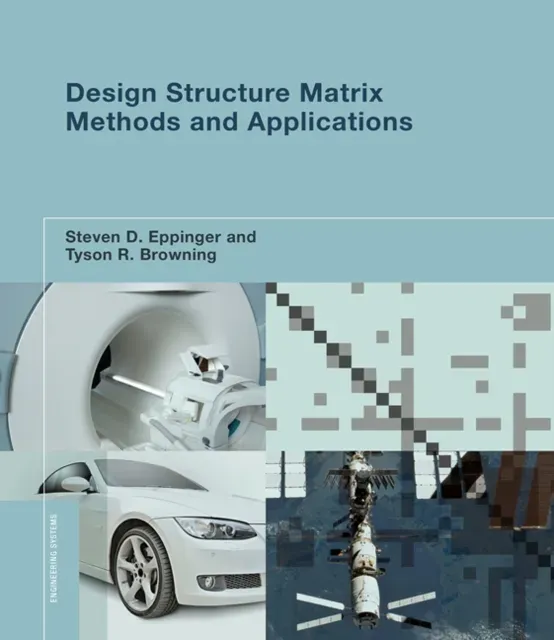
Design Structure Matrix Methods and Applications
Tyson R. (Associate Professor of Operations Management Browning
£53.04
Decision-Making Under Stress
Lynne Martin
£204.00
Introduction to Research Methods and Data Analysis in Psychology
Gareth Hagger-Johnson
£80.90
Social Work Dissertation: Using Small-Scale Qualitative Methodology
Malcolm Carey
£34.79

Reengineering the Survey of Income and Program Participation
£61.43
Elements of Information Theory
Joy A. (IBM T. J. Watson Research Center Thomas
£115.82
Introduction to Qualitative Research Synthesis
Maggi (University of Coventry Savin-Baden
£41.99

Qualitative Research in the Health Sciences : Methodologies, Methods and Processes
Bev Taylor
£62.39

Wiley Encyclopedia of Operations Research and Management Science, 8 Volume Set
£3,308.34
Research and Fieldwork in Development
Mark Graham
£91.19