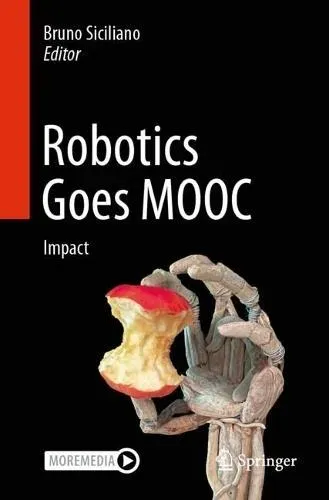
Robotics Goes MOOC : Impact
Title:
Robotics Goes MOOC : Impact
Author:
Format:
Paperback
Number of pages:
479 pages, 187 Illustrations, color; 10 Illustrations, black and white
Publisher:
Springer Nature B.V.
ISBN-13:
9783319772660
EAN:
9783319772660
Classifications:
Research and information: general
Weight (g):
888
Dimensions (mm):
155 x 236 x 30
Publication Country:
United Kingdom
Language:
English
Condition:
New
Price:£52.49
1 copies in stock
Qty

Description
It is often read in the media that AI and Robotics are the primary cause of technology unemployment. AI and machine learning techniques are expected to take over lower-level tasks, while humans can spend more time with higher-level tasks. In perspective, it can be said that jobs requiring boring cognitive tasks or repeatable and dangerous physical tasks will be considerably shredded by automation thanks to the wide adoption of AI & Robotics technology to replace humans, while jobs requiring challenging cognitive tasks or unstructured physical tasks will be suitably re-engineered with the progressive introduction of AI & Robotics technology to assist humans.From the discussion above, it should be clear that in a world populated by humans and robots, issues arise that go beyond engineering and technology due to the impact resulting from the use of robots in various application scenarios. The anthropization of robots cannot ignore the resolution of those ethical, legal, sociological, economic (ELSE) problems that have so far slowed their spread in our society.The final book of the Robotics Goes MOOC project enlightens the impact of using robotic technology in the main fields of application, namely, industrial robots as in Chapter 1 by Bischoff et al, medical robotics as in Chapter 2 by Dario et al, aerial robots as in Chapter 3 by Ollero et al, orbital robotics as in Chapter 4 by Lampariello, underwater robots in Chapter 5 by Antonelli, and rescue robots as in Chapter 6 by Murphy. The last part is devoted to the open dilemma of using and accepting robots in human co-habited environments which is addressed in Chapter 7 on social robotics by Pandey and the very final chapter by Tamburrini on the important issues raised with roboethics.
Books under Research and information: general
Design Structure Matrix Methods and Applications
Tyson R. (Associate Professor of Operations Management Browning
£53.04
Decision-Making Under Stress
Lynne Martin
£204.00

Introduction to Research Methods and Data Analysis in Psychology
Gareth Hagger-Johnson
£80.90
Social Work Dissertation: Using Small-Scale Qualitative Methodology
Malcolm Carey
£34.79
Reengineering the Survey of Income and Program Participation
£61.43
Elements of Information Theory
Joy A. (IBM T. J. Watson Research Center Thomas
£115.82

Introduction to Qualitative Research Synthesis
Maggi (University of Coventry Savin-Baden
£41.99

Qualitative Research in the Health Sciences : Methodologies, Methods and Processes
Bev Taylor
£62.39

Wiley Encyclopedia of Operations Research and Management Science, 8 Volume Set
£3,308.34
Research and Fieldwork in Development
Mark Graham
£91.19