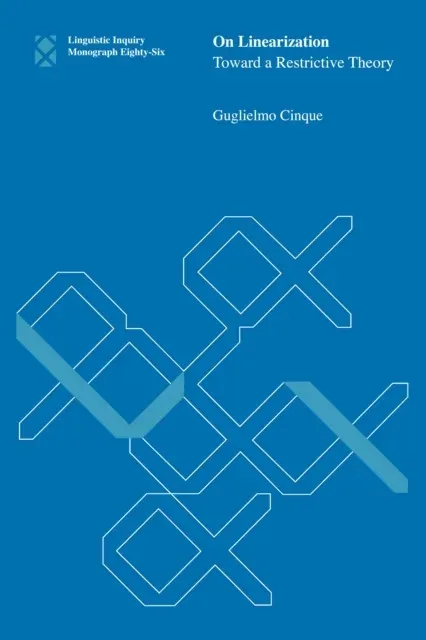
On Linearization
by Guglielmo Cinque
Title:
On Linearization
Author:
Guglielmo Cinque
Format:
Paperback
Number of pages:
184 pages
Publisher:
MIT Press Ltd
ISBN-13:
9780262544955
EAN:
9780262544955
Publication Date:
07/03/2023
Classifications:
Language: reference and general
Weight (g):
488
Dimensions (mm):
228 x 153 x 16
Publication Country:
United Kingdom
Language:
English
Condition:
New
Price:£38.76
3 copies in stock
Qty

Description
The first attempt at a restrictive theory of the linear order of sentences and phrases of the world''s languages, by one of the founders of cartographic syntax.Linearization, or the typical sequence of words in a sentence, varies tremendously from language to language. Why, for example, does the English phrase 'a white table' need a different word order from the French phrase 'une table blanche,' even though both refer to the same object? Guglielmo Cinque challenges the current understanding of word order variation, which assumes that word order can be dealt with simply by putting a head either before or after its complements and modifiers. The subtle variations in word order, he says, can provide a window into understanding the deeper structure of language and are in need of a sophisticated explanation.The bewildering variation in word order among the languages of the world, says Cinque, should not dissuade us from researching what, if anything, determines which orders are possible (and attested/attestable) and which orders are impossible (and not attested/nonattestable), both when they maximally conform to the 'head-final' or 'head-initial' types and when they depart from them to varying degrees. His aim is to develop a restrictive theory of word order variation—not just a way to derive the ideal head-initial and head-final word orders but also the mixed cases.In the absence of an explicit theory of linearization, Cinque provides a general approach to derive linear order from a hierarchical arrangement of constituents, specifically, by assuming a restrictive movement analysis that creates structures that can then be linearized by Richard S. Kayne''s Linear Correspondence Axiom.
Books under Language: reference and general
Keywords
Raymond Williams
£10.72
Writing With Power
Peter (Professor of English Elbow
£14.84
Everyday Grammar
John ( Seely
£11.54
Easy Learning Italian Vocabulary: Trusted support for learning
Collins Dictionaries
£8.24
Lend Me Your Ears
Max Atkinson
£16.49
Writing Without Teachers
Peter Elbow
£12.37
Oxford Japanese Grammar and Verbs
Jonathan ( Bunt
£8.24
Pocket Oxford Greek Dictionary
Oxford University Press
£10.49
On Writing Well: The Classic Guide to Writing Nonfiction (Anniversary)
William Zinsser
£16.86
Rollercoasters The Boy in the Striped Pyjamas
Boyne
£14.24