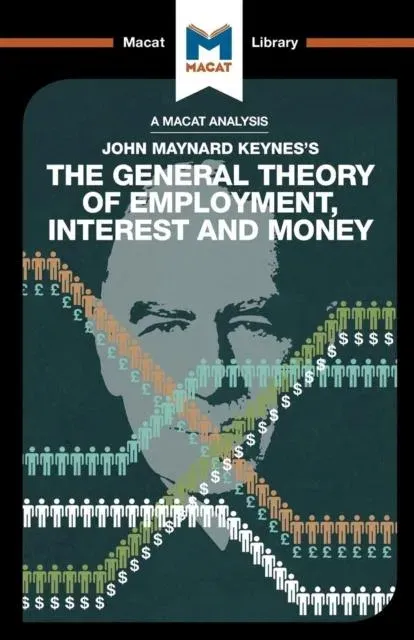
An Analysis of John Maynard Keyne's The General Theory of Employment, Interest and Money
by John Collins
Title:
An Analysis of John Maynard Keyne's The General Theory of Employment, Interest and Money
Author:
John Collins
Series (if any):
The Macat Library
Format:
Paperback
Number of pages:
112 pages
Publisher:
Taylor & Francis Ltd (Sales)
ISBN-13:
9781912127900
EAN:
9781912127900
Classifications:
Literature: history and criticism
Weight (g):
244
Dimensions (mm):
198 x 130 x 6
Publication Country:
United Kingdom
Language:
English
Condition:
New
Price:£7.31
1 copies in stock
Qty

Description
John Maynard Keynes's 1936 General Theory of Employment, Interest and Money is a perfect example of the global power of critical thinking. A radical reconsideration of some of the founding principles and accepted axioms of classical economics at the time, it provoked a revolution in economic thought and government economic policies across the world. Unsurprisingly, Keynes's closely argued refutation of the then accepted grounds of economics employs all the key critical thinking skills: analysing and evaluating the old theories and their weaknesses; interpreting and clarifying his own fundamental terms and ideas; problem solving; and using creative thinking to go beyond the old economic theories. Perhaps above all, however, the General Theory is a masterclass in problem solving. Good problem solvers identify their problem, offer a methodology for solving it, and suggest solutions. For Keynes the problem was both real and theoretical: unemployment. A major issue for governments during the Great Depression, unemployment was also a problem for classical economics. In classical economics, theoretically, unemployment would always disappear. Keynes offered both an explanation of why this was not the case in practice, and a range of solutions that could be implemented through government monetary policy.
Books in the same Series

An Analysis of C. Wright Mills's The Sociological Imagination
Ismael Puga
£7.80
Analysis of Paul Kennedy's The Rise and Fall of the Great Powers
Riley Quinn
£7.31

Analysis of Jean-Jacques Rousseau's The Social Contract
James Hill
£23.99

Bowling Alone
Elizabeth Morrow
£23.99

An Analysis of Zora Heale Hurston's Characteristics of Negro Expression
Mercedes Aguirre
£7.31

An Analysis of Thomas Robert Malthus's An Essay on the Principle of Population
Nick Broten
£7.31

An Analysis of Gilbert Ryle's The Concept of Mind
Michael O'sullivan
£7.31

An Analysis of Natalie Zemon Davis's The Return of Martin Guerre
Joseph Tendler
£7.31

An Analysis of Hannah Arendt's The Human Condition
Sahar Aurore Saeidnia
£7.31

An Analysis of C.S. Lewis's The Abolition of Man
Ruth Jackson
£7.31
Books under Literature: history and criticism

The Mirror and the Lamp: Romantic Theory and the Critical Tradition
Meyer Howard Abrams
£18.97

Japanese No Dramas
Penguin Books Ltd
£12.37
Inventing Ireland
Declan Kiberd
£17.32

Miasma: Pollution and Purification in Early Greek Religion
Robert Parker
£165.38

Passion and Action
Susan (Department of Philosophy James
£72.90

Why Read Marx Today?
Wolff
£10.72

Commentary on Thucydides: Volume I: Books i-iii
Simon (Fellow and Tutor in Ancient History Hornblower
£229.50

Unity in Greek Poetics
Malcolm F. Heath
£165.00

Micromegas and Other Short Fictions
Francois Voltaire
£10.72

Cavalleria Rusticana and Other Stories
Giovanni Verga
£10.72