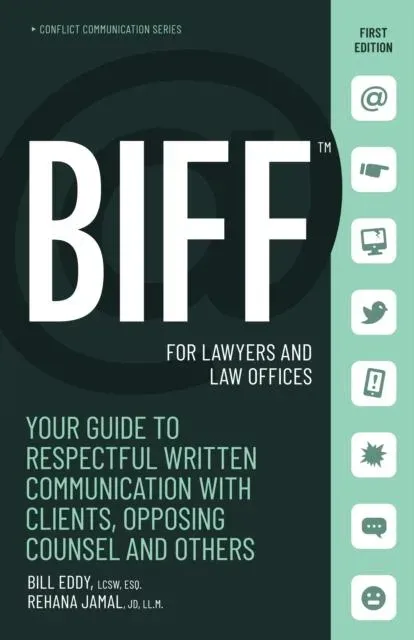
BIFF for Lawyers and Law Offices : Your Guide to Respectful Written Communication with Clients, Opposing Counsel and Others
by Bill Eddy
Title:
BIFF for Lawyers and Law Offices : Your Guide to Respectful Written Communication with Clients, Opposing Counsel and Others
Author:
Bill Eddy
Series (if any):
Conflict Communications
Edited by:
Rehana Jamal
Format:
Paperback
Number of pages:
207 pages, Illustrations
Publisher:
Unhooked Books LLC dba High Conflict Institute P
ISBN-13:
9781950057399
EAN:
9781950057399
Classifications:
Interdisciplinary studies
Weight (g):
398
Dimensions (mm):
140 x 218 x 13
Publication Country:
United Kingdom
Language:
English
Condition:
New
Price:£15.55
2 copies in stock
Qty

Description
"BIFF is simple, powerful, and impactful. This book should be
mandatory reading for the entire legal industry. Once you start to use BIFF, it becomes an
antidote for caustic interactions. You can't
stop the poison, but BIFF gives you the antidote to counteract it safely. Read it, apply it, and start to use power of
BIFF." -Attorney Steve Riley, Atticus shareholder and podcast host of Great Practice. Great Life. Use BIFF to Communicate with Your Ex's Blaming, Accusing and Taunting Texts and EmailsThis book provides
a simple and proven method for lawyers and staff to use in ethically responding to
hostile communications, correcting misinformation by others, and initiating
productive correspondence. The BIFF Communication method can be used by all law office personnel
(paralegals, administrative assistants, receptionists, and others), with 30
sample responses to common situations involving hostile or misinformed emails,
text messages, and other forms of communication. BIFF stands for Brief,
Informative, Friendly, and Firm. The BIFF Communication method can also be taught to clients to help them write friendly and concise
responses in their legal cases, saving lawyers time and reducing the escalation of unnecessary conflicts in their cases. This book explains how to
coach office staff, clients and their family members to use the BIFF Communication method,
including ten easy key questions to ask when reviewing their correspondence.
While this method is designed primarily for written communication, this
approach can also be used in verbal conversations, to be efficient and respectful. The book is divided into five sections: Learning
the BIFF methodCorrespondence with clientsCorrespondence with
colleaguesCorrespondence with staff and between staffCoaching
staff and clients in the BIFF method. Each sample scenario provides a hostile
correspondence received by the lawyer and/or staff member; then gives a tempting
response which is not quite a BIFF (analyzed using the BIFF Checker); then
gives a communication that is a BIFF.
Books by Bill Eddy
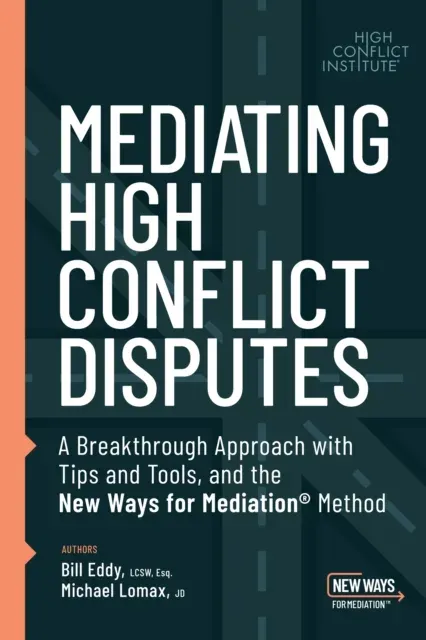
Mediating High Conflict Disputes
Bill Eddy
£28.27
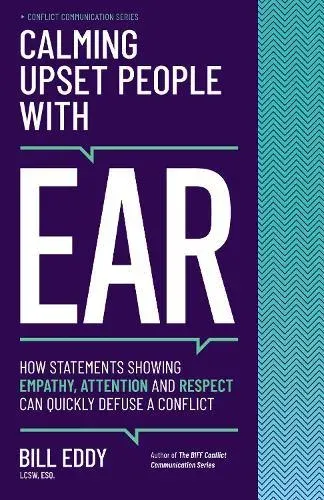
Calming Upset People with EAR : How Statements Showing Empathy, Attention, and Respect Can Quickly Defuse a Conflict
Bill Eddy
£11.69
Books under Interdisciplinary studies
MODERN STRATEGY P
GRAY
£71.99

Effortless Action: Wu-Wei as Conceptual Metaphor and Spiritual Ideal in Early China
Edward Slingerland
£33.74

1988 Lectures and Memoirs
The British Academy
£156.75

Yalta
S. M. Plokhy
£9.07

Why Africa is poor
Greg Mills
£10.72

Causes and Effects of 20th Century Wars: IB History Print and Online Pack: Oxford IB Diploma Programme
David Smith
£75.22

Politics in the Developing World
£65.99

Economic Development: What Everyone Needs to Know
Marcelo Giugale
£9.07

We Are the Voice of the Grass: Interfaith Peace Activism in Northern Uganda
David A. Hoekema
£30.22

World's Most Prestigious Prize
Geir (Former Director of the Norwegian Nobel Institute Lundestad
£18.14